|
|

|
|

|
Download in progress...
Please wait until the complete download of this web page
|
|
X
|
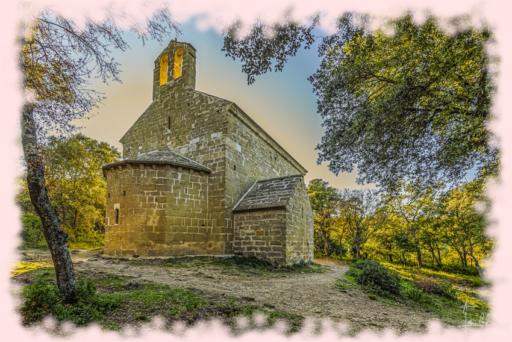
L'église Saint-Denis de Calès
| 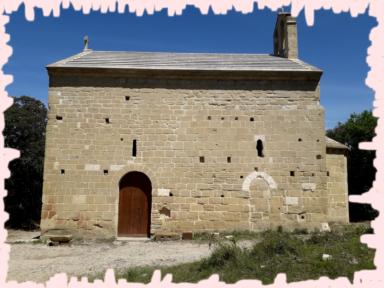
Elle est située côté nord de Calès. On y accède par un chemin pentu s'amorçant au dessus de la fontaine Saint-Denis.
Erigée vers 1150 elle a été la première église paroissiale de la communauté villageoise de Calès et plus tard du village de Lamanon. Lors de sondages réalisés en 1996 une assise antérieure au VIe siècle et de nombreuses sépultures dont les plus anciennes remontent à l'âge du fer ont été découvertes, témoignages de la présence , en ce lieu de cultes anciens .
D'abord propriété des évêques d'Avignon (bulle du pape Adrien IV du 24/11/1155) et dédiée à Saint-Marcellin l'église est achetée le 24 octobre 1496 par le chapitre Notre-dame-des-doms.
Ce bel ensemble roman provençal ne comprenait alors qu'une nef centrale couverte d'un toit de tuiles et une abside semi-circulaire.
Restaurée à la fin du XVe par la famille De Roux de Lamanon, elle est alors surélevée et recouverte d'un toit de lauzes. On lui adjoint également, sur son flanc nord une petite chapelle gothique probablement dédiée à Saint-Denis. En effet les textes retrouvés montrent que, progressivement, à partir de cette époque, le nom de Saint-Denis remplace celui de Saint-Marcellin,la partie ayant peut-être par extension donné son nom à l'ensemble de l'édifice.
D'autres restaurations se dérouleront aux XVIIIe et XIXe siècles puis au XXe et XXIe siècle.
|
| | Afin d' éviter la confusion avec l'église Saint-Denis au centre du village actuel, érigée à partir de 1773, nous la nommons église Saint-Denis de Calès.
Protégée et respectée jusqu'à la dernière guerre elle subit ensuite de nombreux actes de vandalisme: porte défoncée sépultures profanées, autel saccagé, pierres et dalles emportées, sol fouillé.
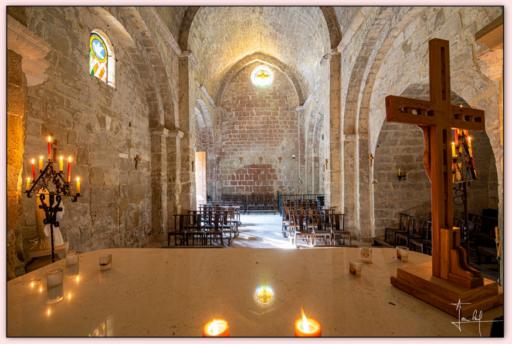
Trois campagnes de restauration étalées sur 10 ans (de 1989 à 1999) réalisées par l'entreprise A. GIRARD d'Aix-en-Provence permettent de sauvegarder ce joyau architectural et culturel.
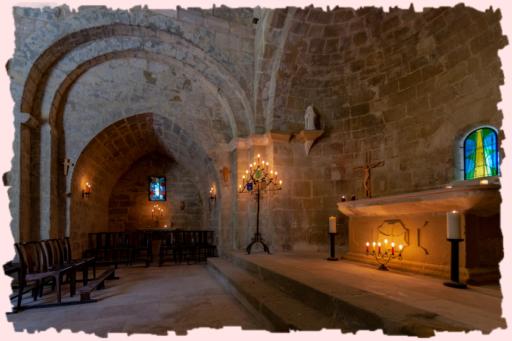
En 1989 l'extérieur est sauvegardé . Puis l'intérieur en 1996 avant qu' en 1999 une dalle de béton maigre soit coulée, l' autel reconstitué et des grilles posées ...
En 1996, des sondages avant travaux ont permis la découverte de nombreux objets exposés au musée de Calès, dont un peigne en os du VIe siècle.
L'association a été maître d'oeuvre pour 80% des travaux, la municipalité pour la partie restante.
En 2018 la municipalité prend en charge la réfection du toit, la pose d'un carrelage en travertin, la création d'un autel dans la chapelle nord et la pose d'une dalle sur l'autel dans le choeur.
Grâce à ces campagnes de restauration, cette église demeure le seul élément intact de l'occupation médiévale de Calès.
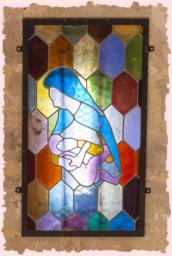
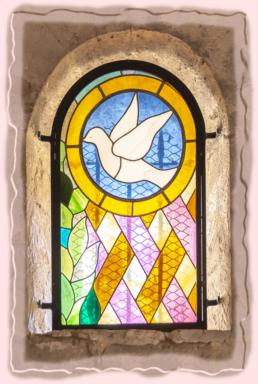
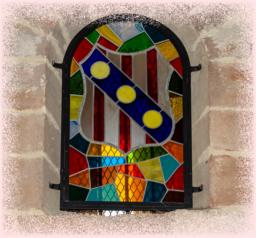
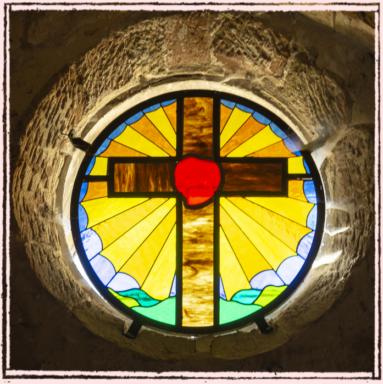
L'association Calès-Saint-Denis l'a aménagée de bancs, d'une statue de St-Denys et a offert un chemin de croix en bois (2015)et six vitraux (de 2016 à 2019 ).
Ces oeuvres ont été réalisées par des Lamanonais et complétées par un crucifix offert par la présidente.
|
| | 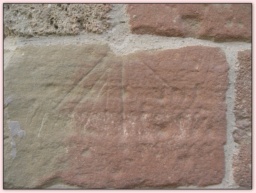 Dès le IXe siècle, Bède le Vénérable, en Angleterre, décrit les cadrans solaires canoniaux utilisés dans les monastères pour appeler les moines à la prière et au travail. Dès le IXe siècle, Bède le Vénérable, en Angleterre, décrit les cadrans solaires canoniaux utilisés dans les monastères pour appeler les moines à la prière et au travail.
Du XIe au XVe siècle, en France ces cadrans sont partout dans les abbayes, les chapitres cathédraux et leurs dépendances, les collégiales. Ils sont gravés en général sur le mur sud des églises.
À l'église Saint-Denis de Calès, trois cadrans sont répertoriés. Le fait qu'il y en ait plusieurs sur une même église indique simplement qu'ils ne sont pas contemporains : ils s'étagent dans le temps. Les lignes horaires extrêmes indiquent 6 h du matin à gauche et 6 h du soir à droite. Les heures intermédiaires sont indiquées suivant la nécessité à la craie. Le cadran canonial est le schéma directeur de la vie paroissiale.
À partir du XVe siècle, les cadrans solaires deviennent davantage liés à la coutume : ils quittent les églises et s'inscrivent sur les édifices publics et les maisons.
L'heure au Moyen Âge : la journée du lever au coucher du soleil était divisée en 12 heures égales. En conséquence, les heures d'été étaient beaucoup plus longues que les heures d'hiver : 80 mn à la St-Jean d'été, 60 mn aux équinoxes, 41 mn à Noël.
Entre 1277 et 1300, l'horloge est inventée. Elle remplacera progressivement le cadran solaire.
|
| |
|
| Copyright © 2024. Tous droits réservés. | |
|
|
|